

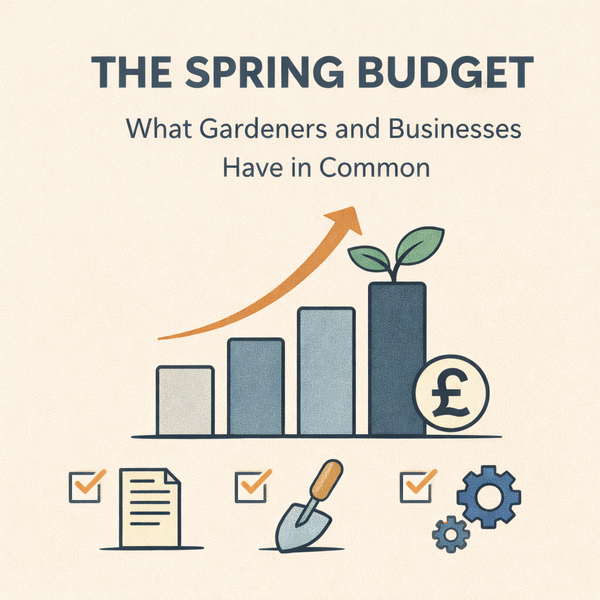
The Spring Budget: What Gardeners and Businesses Have in Common
The Quick Read
Spring is a time of renewal - in gardens and in business finances. Around the same time, the UK government usually announces the Spring Budget, setting the tone for the financial year ahead.
Like gardening, good financial planning follows a few simple principles:
1. Prepare the soil
Strong financial foundations make growth possible.
2. Plant carefully
New investments should be considered, not rushed.
3. Prune regularly
Removing unproductive costs helps the healthy parts of a business grow.
4. Think long-term
Sustainable growth takes patience and planning.
✅ Bottom line: Just like a garden, a healthy business grows best with careful preparation and regular attention.
Want to dig deeper? Here's how the gardening mindset can help businesses plan finances more effectively.
The Deep Dive
1. Prepare the Soil
In gardening, good soil supports healthy plants - in business, the equivalent is clear financial information.
That means:
- Accurate bookkeeping.
- Reliable cash-flow forecasting.
- Understanding your profit margins.
Tip: If your numbers are unclear, decisions become guesswork. A strong financial base makes every other step easier.
2. Plant Carefully
Spring is when gardeners choose what to plant. Businesses also make key decisions at this time of year.
Examples include:
- Hiring new staff.
- Investing in equipment or technology.
- Expanding services or markets.
Tip: Before making new investments, consider both the immediate cost and the long-term return.
3. Prune Regularly
Gardeners remove dead branches so healthy ones can grow stronger - businesses sometimes need to do the same with spending.
That might mean:
- Reviewing subscriptions and recurring costs.
- Dropping unprofitable services.
- Simplifying complicated processes.
Tip: Small savings across multiple areas often add up to significant improvements.
4. Think Long-Term
A garden planted in spring rarely blooms immediately - and business growth works the same way.
Sustainable progress usually comes from:
- Consistent financial monitoring
- Careful reinvestment
- Patience rather than quick wins
Tip: Financial planning should look beyond the next quarter and consider where you want the business to be in several years.